
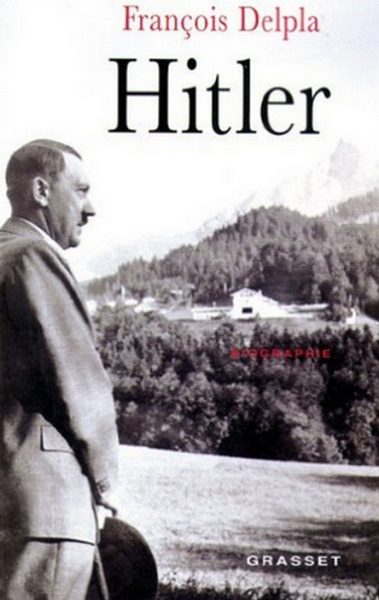
The sheer number of books devoted to Hitler might suggest that this first French biography would offer few surprises to its reader. However, this is far from the truth, for François Delpla's work is radically innovative, both in its methodology and its sources. Until now, Hitler's personality had been obscured by the darkness of his crimes, and this darkness had been projected onto his every action, sparing historians the basic task of critical analysis.
The sheer number of books devoted to Hitler might suggest that this first French biography would offer few surprises to its reader. However, this is far from the truth, for François Delpla's work is radically innovative, both in its methodology and its sources. Until now, Hitler's personality had been obscured by the darkness of his crimes, and this darkness had been projected onto his every action, sparing historians the basic task of critical analysis. Vast interpretive frameworks—in which Marxism played a role, as did psychologism—had sought to highlight his perversions, or the weighty historical context of which he was merely an expression, rather than the unbridled coherence of his mind and his vision. Indeed, Adolf Hitler's education, though self-taught, was neither nonexistent nor insignificant. From 1919 onward, he conceived a precise plan, and he implemented it with perseverance and skill. It would be quite futile to think of Hitlerism by reducing the seduction it exerted to crude fabrications… In short, for the first time, this biography takes Hitler seriously, that is to say, tragically. This biography is therefore an act of faith in the dignity of historical scholarship. Under the scrutiny of its analyses, and as Alexandre Adler notes in his preface, the history of this terrible episode is not embellished. It is simply more robust. A graduate of the École Normale Supérieure and an agrégé in history, François Delpla first highlighted Churchill's solitary struggle against Hitler (Churchill and the French, 1993) before focusing his work on the Führer (Montoire, 1995; The Nazi Ruse, 1997). He also took part in debates on the French Resistance (Aubrac, the facts and the slander, 1997).