

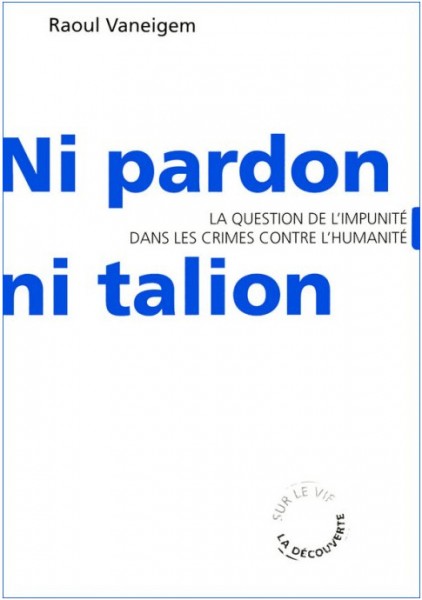
"Never again!" This was the objective of the concept of crimes against humanity, legally defined in 1945 to punish Nazi criminals and put an end to barbarity forever. Yet, since then, massacres and genocides have not ceased.
“Never again!”: such was the objective of the concept of crimes against humanity, legally defined in 1945 to punish Nazi criminals and put an end to barbarity once and for all. Yet, since then, massacres and genocides have not ceased. And we live in a world where power demands ever more disorder to impose its mafia-like protection, more inhumanity to lend luster to the humanitarian lie, more violence to preserve business interests. In this world, what can justice mean? It is this unbearable paradox that Raoul Vaneigem tackles in this book, by revisiting the foundations of modern justice. For him, as long as freedom remains the ideological product of free trade, justice will be limited to correcting man, a commodity rather than a human being. For while capitalism and superficial humanism have broken with vengeance and the law of retaliation, the role of justice has since been confined to limiting the excesses of an inhumane system. However, forgiveness is not an alternative to punishment: far from making people better, it hardens them into the idea of fate and compassion. Neither forgiveness nor retaliation: both necessary and insufficient, judicial institutions can only be the starting point of a broader struggle against universal barbarity, founded on a consensus on human rights, patiently achieved through a new education and the emergence of a new way of life: acting locally with a global perspective, uniting everywhere the vital forces of individuals aspiring to happiness. Vaneigem does not mock the advances of justice; he merely argues that, pushed ever further, human progress will render them obsolete.