

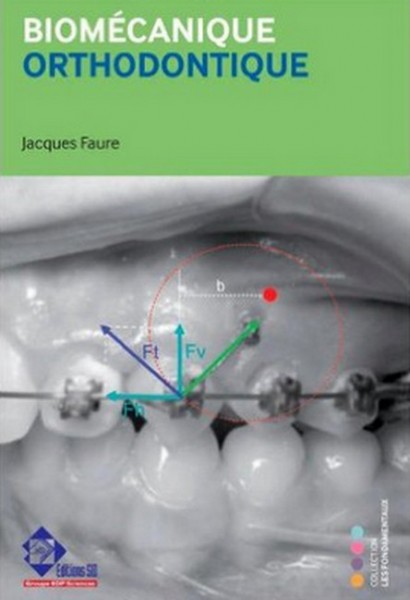
The book on orthodontic biomechanics first explains how an applied system of forces will modify the statistics of a tooth or a group of joined teeth, and will thus initiate movement by triggering bone remodeling.
Based on the equilibrium equations and known results of beam mechanics, the author determines the actions exerted by a spring fixed at its two ends: this applies to arch elements joining two consecutive brackets but also to classic brackets such as the quad'helix.
The book on orthodontic biomechanics first explains how an applied system of forces will modify the statistics of a tooth or a group of joined teeth, and will thus initiate movement by triggering bone remodeling.
Based on the equilibrium equations and known results of beam mechanics, the author determines the actions exerted by a spring fixed at its two ends: this applies to arch elements joining two consecutive brackets but also to classic brackets such as the quad'helix.
The summation of the actions of the archwire elements allows us to understand the mechanics of the continuous archwire. The archwire-bracket connection is the keystone of orthodontic action, and the author analyzes the loss of information in both conventional and self-ligating brackets.
The analysis of the mechanics of connected solids is then reviewed and applied to commonly encountered connections:
– sliding or rail system;
– anchoring a point of the arch on a mini-implant using a metal ligature, limiting arch movements.
The final chapters demonstrate the application of these theoretical analyses in everyday clinical situations:
– general strategy: overall arcade movement, generally in two stages or sectoral movement;
– direct mechanics or indirect mechanics;
– sliding type connection or absence of rigid connection;
– absolute anchoring or anchoring reinforcement by extra-oral force.
This book is primarily intended for dental students specializing in orthodontics, for whom understanding the mechanics of dental procedures is essential. However, it will also be of interest to their more experienced colleagues, the established practitioners. These professionals are faced with increasingly complex clinical cases and use constantly evolving tools (mini-screws, active self-ligating brackets, etc.). It's no longer possible to rely on the old Class II 1 DDM syllabus learned during the CECSMO years! It's necessary to "invent the mechanics."
Learning to analyze even the most complex mechanics will help the reader implement appropriate treatments, particularly in atypical clinical situations. A deep understanding of the principles of action of orthodontic tools will aid them in the constant evolution of orthodontics towards new technologies, new materials, new instruments, or simply materials with enhanced performance. From this perspective, this book will also be of interest to researchers and inventors of tomorrow's orthodontic technology.
Dr. Jacques Faure (DE) taught at Paul Sabatier University (Toulouse III), initially focusing on mechanics and thermodynamics for about ten years, then orthodontics as a lecturer in dentofacial orthopedics, head of department, and director of specialty training. He practices orthodontics privately in his office located in the Midi-Pyrénées region.